
Improving Soil Health in Tribal Areas: Key to Sustainable Agriculture and Food Swaraj
Published on January 14, 2026
Summary
This policy brief advocates for improving soil health in tribal areas, particularly in Rajasthan, by shifting from chemical-intensive farming to sustainable, traditional methods. It recommends policy changes to conserve topsoil, decentralize soil testing, and support organic practices to ensure food security.
Improving Soil Health in Tribal Areas
Key to Sustainable Agriculture and Food Swaraj
POLICY BRIEF
Introduction
The rate of population growth in world has started declining recently but even then, there would be about 9 to 10 billion people on this planet by mid of twenty first century and the demand for food will almost be double because of a) rising demand for food due to increasing income, b) shift in diet to more animal-based consumption that will require more agricultural production to maintain same nutritional value and c) a large backlog of unmet requirement for food; we must remember that about 800 million people, which is almost 13% of world's population is undernourished.
The green revolution technologies wherein the application of genetic technology, application of chemical fertilisers and pesticides to increase food production world over have played its role. But its gains are now diminishing as shown by declines in marginal productivity of agricultural inputs. For example, the worldwide rate of increase in cereal production, having been 2.4 percent in the 1970s and 2 percent in the 1980s, has been less than 1 percent in the 1990s (FAOSTAT, 1998). In fact, the adverse impact of green revolution technologies on quality of water (seepage of pesticides and fertilisers, residual pesticides in food, acidification of soils etc.) are visible world over. The scientific community and farmers across the globe are convinced that the next agricultural revolution to have increased food production in a sustainable manner will be based on Integrated Soil Fertility Management (ISFM) and Sustainable Soil Health Management.
As the most significant medium for agriculture, soil is the chief enabler for feeding and nourishing everyone on earth. Soil has incalculable economic, environmental and social value-as a habitat for billions of living organisms, a source of biofuel energy, medicines and clothing, by providing ecosystem services such as filtering water, and by naturally sequestering carbon to help build resilience against events caused by climate changes. Agriculture using soil is the largest economic activity on earth and involves the greatest number of humans. As our global population grows, the opportunities for responsible investment delivering sustainable returns are considerable. Soil must be recognised as a 'scarce resource'. It should be mapped, classified and become a foundation for all policy on sustainable agriculture and food security.
The soil formation is an extremely slow process, it takes a vast amount of time to form one meter of soil through physical, chemical weathering and biotic process. For example, in Europe, it takes about 100 years to form one centimetre of soil, in tropical areas the time taken is slightly less. But the soil erosion from agricultural fields is 10 to 20 times faster than its formation; though it depends on land slope and tillage practices, sloppier the land, higher is the rate of erosion.
There is now increased appreciation for Soil Health globally as well as at national level. The United Nations have also Global Compact Principles for Sustainable Soil Management (“Soil Principles”) in 2016. They respond to the call of the Sustainable Development Goals and Agenda 2030 to eliminate poverty, hunger, and promote sustainable use of terrestrial ecosystems.
In India, the importance of soil and soil health has been recognised since the last two to three decades. The Integrated Watershed Management Program of the government focused on in-situ soil and water conservation; but the focus was more on water harvesting by building anicuts and check dams rather than on conserving top soil. And more recently the Soil Health Card Scheme of the government addresses the need of only necessary doses of fertilisers; it also focuses on soil testing and recommending fertilisers doses; it is far from 'soil health'. Government has also launched various programs like traditional agriculture, organic agriculture and so on.
During Covid 19 pandemic, when a nationwide lockdown happened, the country witnessed hordes of migrant labour walking on roads going back to their homes from the towns and cities. These were the most vulnerable people as they did not have any resources to continue in their place of working. A huge number of them were tribal people coming back to their homes in the central tribal region comprising MP, Jharkhand, Chhattisgarh, parts of Odisha & Bihar and southern Rajasthan.
In Rajasthan there are seven districts where almost 90% of the state's tribal population lives and these districts are Udaipur, Banswara, Dungarpur, Sirohi, Pratapgarh, Jhalawar and Pali. Almost 70% of the rural households in these districts have at least one person migrating to towns and cities as wage labour to sustain their families. The tribal areas are also the hilly areas, it has the highest average annual rainfall in the state but also has lowest agricultural production and productivity. The area has lowest development indices, lowest human development index, and high level of malnutrition and anemia among women. Due to hilly terrain, only about 43% of total geographical area in the tribal region is 'cultivable' whereas in rest of Rajasthan it is 74%.[1]
UN Global Compact Principles for Sustainable Soil Management (February 2016)
Protect Soil from Physical, Chemical and Biological degradation, limit erosion and avoid deforestation
Restore Soils on degraded and marginal lands
Maintain Soil-based ecosystem Services, water availability and quality
Enhance soil productivity according to its natural capacity
Develop extension services, knowledge systems, and promote innovation
Salient features of agriculture in tribal areas vis a vis that of rest of Rajasthan
S. No.ParticularsRajasthanTribal Area1.Land available for agriculture as % age of total geographical area74.3%43.6%2.Use of Chemical Fertilisers (Kg/ Hectare)59.283.43.Soil Erosion – Exclusively Water Erosion (>10 tonnes/ha/year)¹21.7%58.9%*4.Soil Testing Laboratories (in numbers)104195.Yield of major crops (Kg/ha) **a. Cereals19261780.6b. Pulses585900.3c. Oilseeds12541088.4
*Based on water erosion data of Banswara, Dungarpur, Udaipur, Chittorgarh, Rajsamad and Sirohi districts
**Based on average data of last 5 years from 2017-18
One of the issues that the tribals have been raising is 'the status of agriculture in tribal areas.' It seems that the condition of agriculture in terms of its ability to provide food & nutrition; providing income to raise the family and in terms of providing employment; has not improved; in fact, it has worsened. Especially for small and marginal farmers in tribal areas whose lands are in hill tops and on slopes, agriculture is no longer the 'primary occupation' for them. Though, they have not entirely stopped cultivating their fields but they just spread seeds and wait for their luck! If the rains are good, they get a few bags of maize and a few kilos of pulses. Otherwise, they sustain their families from the wages they get by working as migrant wage labour.
It seems that the focus of national agricultural policy on increasing food production through wide scale adoption of 'green revolution technologies' whereby the emphasis is on high yielding varieties, use of chemical fertilisers, pesticides and irrigation; has not really benefited tribal area agriculture. Because in tribal areas the land is sloppy, irrigation facilities are almost negligible and tribal farmers lack resources to apply agricultural inputs. The policy should promote local decentralised systems which the tribal community itself can manage. This note is for preservation of top soil and managing soil health for sustainable agriculture in tribal areas of Rajasthan.
The National Resources Conservation Service of USA defines soil health as “the continued capacity of soil to function as a vital living ecosystem that sustains plants, animals, and humans.” Attributes of healthy soils include a diverse population of beneficial organisms, high levels of decomposed organic matter, low levels of toxic compounds, adequate (rather than excessive) levels of nutrients, a sufficiently porous surface, and good tilth.
Healthy soil is the most basic ingredient for healthy agriculture. But the focus of agriculturists, agricultural scientists as well of agriculture policy makers has been on 'crop health' rather than on 'soil health'. The agricultural production has been used as a proxy for soil health which is a wrong proxy.
Healthy soils reduce nutrient leaching; more nutrients are recycled and can be used by crops again. This means that less nitrogen makes its way into groundwater and other waterways, preventing water pollution. Healthy soil holds more water and releases less water to evaporation. Thus, fields would not have to be over-irrigated, a major cause of salinization, and would also be more resilient to drought conditions. Healthy soils also improve plant health and yields, have the potential to sequester and reduce greenhouse gases, reduce sediment erosion and dust, improve water and air quality, and can promote biodiversity and provide wildlife benefits. The agriculture in tribal areas has changed significantly during last 2-3 decades. Traditionally, the agriculture practices in tribals areas were far more self-reliant and sustainable and more tuned to maintaining soil health. Tribal farmers traditionally practiced an 'integrated farming system' wherein they had a few cattle, backyard poultry, crop selection suited for consumption (and not cash crops) and mixed cropping. They knew the importance of soils and therefore, used to put stone wall, vegetative barriers on the boundaries of agricultural fields to stop soil erosion. A typical tribal farmer will have a few horticulture trees, a kitchen garden to grow seasonal vegetables, a few poultry birds, a few cattle (the dung of which is used as manure in agriculture fields) and so on. The sole purpose of agriculture used to be 'to grow enough food, fodder, fuelwood, and fibre for the household'. There are enough traditional practices in tribal areas which are useful for maintaining soil health.
But due to various reasons, the government's agriculture policies focussed on monocropping and promoting cash crops like cotton and soyabean, the agricultural practices in tribal areas have changed and the traditional practices like integrated farming system, multi-cropping, mixed cropping, application of FYM, etc. have disappeared. The cost of cultivation of cash crops like cotton is high due to higher consumption of fertilisers. Both the cotton and soyabean crops are pest sensitive crops, therefore, high use of pesticides is also needed. As a result, the farming has become riskier and high external input based.
There is an urgent need for relooking at Agriculture in tribal areas with the focus objective of supporting 'food sovereignty' while putting greater emphasis on sustainability. The farming practices at farmers level, though are critical, but one must appreciate and acknowledge that the macro agricultural policies are key to promote sustainable agriculture in tribal areas. There is an urgent need for a collaborative effort by research institutions, farmers, private companies and government to promote sustainable agriculture, and the starting point is to go for 'sustainable soil management'. Following are the areas which need policy changes for ensuring Sustainable Soil Health which will ensure sustainable agriculture in tribal areas and make tribal farmers food secure.
Revamping Agriculture Research
The agricultural research approach has to be changed drastically. There should be greater involvement and ownership of farmers while on the research issues and research projects. Farmers are currently involved in research for extension activities only, but their involvement in research is lacking. In the present system, the research is conducted by the scientist, seeking inputs from government officials and not the farmers directly. This approach has not produced desirable results which is evident from tribal farmers leaving agriculture and opting for manual labour in towns and cities. The agriculture research approach should consider tribal farmers as research partners and scientists should help farmers to experiment and do research on their farmers. A robust mechanism needs to be developed for involvement of farmers in proximity of research universities, who should be guided and technically supported by the scientists to evolve good and sustainable soil health practices.
There should not be further research on chemical fertilisers, rather the research agenda should be around - how to stop erosion of topsoil; through various types of bunding, different types of vegetative cover, different ways of tillage, and so on. Other research topics can be around 'increasing microbial population, organic carbon in soils – through use of different crop rotation, application of FYM, biofertilizers and so on. Farmers should be active participants in designing and carrying out such on-farm research.
Focus on crop nutrition
First step towards crop nutrition would be the soil testing and mapping the soils in tribal areas for current status of major & micro nutrients; organic carbon, microbial population and so on. This task should be taken up in a drive mode (without waiting for farmers to bring soil samples and waiting for a test report for months). Presently, there is hardly any tribal farmer who has got soil test reports on time and there is practically no mechanism in place where farmers can understand the reports and follow up the recommendations.
The Government of Rajasthan has proposed to initiate "Rajasthan Land Fertility Mission " in its budget declaration 2022-23, according to which 2 lakh farmers will be benefited with sun hemp seeds for green manure production. Still, there is a need to enrich soil nutrition specifically, organic carbon. Further, the high temperature due to global warming is also impacting in reducing carbon content in the soil through plants. There is a strong need to increase bio-char content in the soil for increasing carbon content. Tribal youth can be trained on various aspects of Sustainable Soil Health including soil testing for nutrients as well as microbial status etc. and also for suggesting appropriate application of nutrients in soil through FYM, Vermi compost, etc. One such trained youth (man or woman) per gram panchayat would be very effective to encourage the farmers to take up Sustainable Soil Health practices. This intervention will help in reducing the excessive use of chemical fertilisers (and lower the cost of production) as well as encourage sustainable agriculture in tribal areas.
Saving top soil in tribal areas
The tribal areas of Southern Rajasthan receive heavy rainfall. Average annual rainfall is above 820 mm and precipitates for 42-43 days, owing to which soil erosion is a regular feature in these areas.
DistrictAnnual Normal RainfallBanswara880.9Dungarpur676.1Pratapgarh910.2
Source: Rajasthan Agricultural Statistics at a Glance 2018-19
On an average, approx. 2.7 metric tons of top soil per hectare gets washed away from agricultural fields in hilly areas of southern Rajasthan. The top soil is precious for agriculture because it has necessary nutrients to support the crops. In hilly areas, top soil is even more critical because the soil depth is less and there are rocks underneath, and once the top soil gets washed away, it becomes difficult to grow any crop. The value of top soil can only be understood by the fact that in nature, to get one cm of soil formed it takes about hundreds of years. Besides, the top soil helps in retaining moisture which is again extremely critical for cropping.
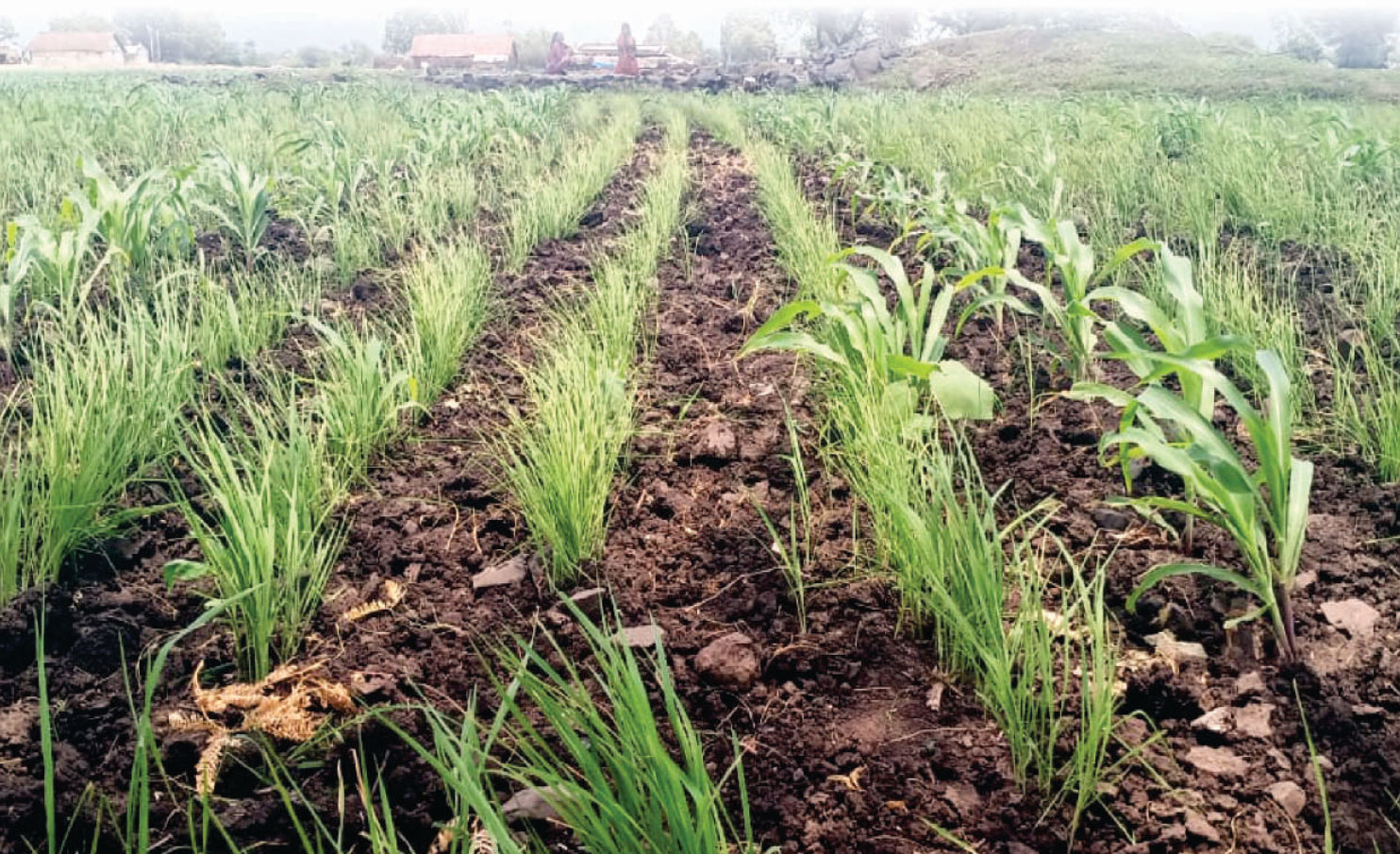
Photo: Sloping Agricultural Land Technology (SALT) to control soil erosion
The top soil loss in hilly areas has increased with deforestation. When there is a forest cover, the tree roots keep the soil bound and also reduce the velocity of runoff; thus, reducing soil erosion. But once forest is not there the top soil gets washed away with water along with soil nutrients. The soil loses water holding capacity and it is not able to support the vegetation. Thus, it is a vicious cycle.
Government should come out with a policy to minimise topsoil loss in hilly areas. There are appropriate technologies already available with farmers like field bunding, planting vegetation on field boundaries, field levelling & making small terrace farm fields, Sloping Agriculture Land Technology (SALT), and so on. It is estimated that it would require approx. Rs. 5000 to Rs. 10000/- per ha to stop the topsoil loss. This investment is mainly on labour and a small component on material like planning material, boulders etc. But as the tribal farmers do not have sufficient resources to invest on these and also there is no assured returns on the investment in a short time frame, farmers do not make any investment on their fields.
Government should help tribal farmers to minimise/ stop topsoil loss from their agricultural fields. This can be done by using MGNREGA where it already has the provisions to support the poor to build/ augment their agricultural assets. Government may target approx. 15-20% farmers every year and support them under MGNREGA to strengthen field bunding, land levelling, planting trees/shrubs on field boundaries etc. This will provide local employment and will improve agriculture.
All gram panchayats in tribal scheduled areas may be encouraged/ asked to prepare a 7-10 years action plan to minimise topsoil loss exclusively through category 4 works under MGNREGA. Local civil society organisations can help the villagers in preparing this plan.
Reclamation of water-logged soil
The injudicious use of irrigation canals is causing water logging and impacting the soil nutrition. The Southern Rajasthan areas during kharif season receive heavy rainfalls due to which the rainwater gets collected in low-lying areas, which causes water-logging. With the construction of Mahi Bajaj Sagar dam in Banswara district and Som-Kamla-Amba dam in Dungarpur district, a canal distribution system was developed for irrigation. Due to hilly areas and poor management of canals, the excessive use of water and seepage loss, causes water stagnation, which leads to water logging. According to a study, about 15,000 Ha of area in Banswara district and 3,000 Ha in Dungarpur district is water logged. Such a water-logged area needs to be reclaimed through use of gypsum to make it fertile.
Promote sustainable soil health
It is mainly the 'crop health' which farmers as well as the agriculture department is concerned about. Though, recently there is some discussion on soil health. For sustainable agriculture and particularly in rainfed hilly areas, soil health is an extremely important aspect which needs immediate policy attention. At present, the government policy and program are limited to 'soil health card' scheme; in tribal areas, even the soil health card scheme is not being implemented properly.
To maintain soil health, soil nutrients and microorganisms are important factors. The first step towards soil health is soil testing. Because a thorough analysis of soil will inform the nutrient composition and status of microorganisms in soil. Government has launched a 'soil health cards' scheme recently under which every farmer is supported to get his/her soil tested and use the fertilisers according to the requirement. The soil tests do not measure soil microorganisms but it tests most macro and micro nutrients along with organic carbon. There are operational problems in soil health card schemes, especially in hilly areas.
First, there are only a few soil testing facilities in tribal areas, and many of them are not even properly functioning. The hilly terrain further complicates the situation because the collection of soil samples and transporting them to testing facilities become time consuming, costly and cumbersome. As a result, it delays the testing and also the tests are not correct. By the time the test reports reach the farmers, they have already sown the crops. Lack of financial resources with farmers to purchase recommended fertilisers is another impediment.
What should be done?
Decentralisation of soil testing facilities is the key. The local youth should be trained in soil testing and a basic soil testing facility should be established at Gram Panchayat or at a cluster of 3-4 Gram Panchayats. The trained local youth can run the soil testing facilities as entrepreneurs. A basic unit of soil testing will cost approx. Rs. 2 lakhs, which should be provided by the government as initial capital support (grant) fully or partly.
In tribal areas, a proper soil health index should be prepared for every block/ district. The Soil health index would include the status of all major and micro nutrients (deficiency); organic matter, moisture retention capacity of soil, soil depth, and status of microorganisms. Then, there should be a policy focus on improving the 'soil health index' and annual monitoring should be done for that.
There are proven technologies available for improving soil health; for example- green manuring, replacing chemical fertilisers with NADEP manure, vermicompost, mixed cropping and so on. Government should prepare a policy to encourage soil health improving technologies in tribal areas for having sustainable agriculture.
Also, the youth should be trained to suggest appropriate application of organic manure fortified with necessary micro nutrients which are deficient in soils. They should also be trained on organic manure technologies like making of Farm Yard Manure, NADEP, vermiculture, and so on.
Encourage agriculture by slowly reducing chemical use in Agriculture
The use of chemical fertilisers by tribal farmers is low as compared to the farmers in the rest of the country. It is mainly because of lack of financial resources with tribal farmers to buy chemical fertilisers and also because of lack of timely availability. Now, the government has also declared Dungarpur as an 'organic district' for agriculture. This is a good policy initiative. But it should be supported by other supporting policy measures.
There is a fertiliser subsidy in India and farmers which encourages farmers to use chemical fertilisers. As tribal farmers do not use chemical fertilisers or use them in low quantities, they do not get the benefit of this subsidy.
What should be done?
Government should provide incentives to tribal farmers for 'not using chemical fertilisers' and for using 'organic manure'. The amount of subsidy can be exactly equal to the subsidy amount which they are forgiving by not using chemical fertilisers. For example, if a farmer was to use one bag of urea, s/he is forgiving Rs. 900/- which is the subsidy on urea. So, s/he can be provided the same subsidy on the organic manure which s/he can either prepare on her own or buy from someone. This will create a local market for organic manure and local youth would also take up making organic manure as local enterprises.
Overall, the agricultural policy for tribal areas should be around 'sustainability' rather than for 'productivity enhancement'; the policy should be 'community centric'- (looking at socio-economic condition of tribal) rather than 'cut & paste'; and the policy should encourage decentralisation-involving community in agricultural research, extension, seed production, developing PoP and so on.
Policy recommendations to be considered
Use MGNREGA for building agricultural assets of tribal farmers with the prime aim of conserving/ saving topsoil of agricultural fields. A number of appropriate and traditional technologies are available. The tribal farmers presently do not have enough capital to invest in agriculture and the returns from agriculture are not guaranteed (due to lack of assured irrigation and uncertainty of rainfall). Therefore, farmers should be paid from MGNREGA to work on their own lands for about 100 days in a year for bunding, putting vegetative hedge on field boundaries, making Compost Pits, making Vermi compost etc.
Local youth (about two youths per Gram Panchayat) should be trained and deployed as 'Sustainable Soil Management Community Resource Persons- (SSM CRP)'. They would help farmers in their respective Gram Panchayat to get their soil tested, recommend the desired nutrients in terms of quantity of Vermicompost, FYM etc. for various crops. SSM-CRPs will also train farmers to make bio fertilisers, and will provide other agricultural services. These CRPs will also run and manage soil testing facilities as entrepreneurs; the government may support them for initial five years with suitable fellowship.
The agriculture research should be participatory involving about five farmers per village (selected in Gram Panchayat, but on a transparent & objective criteria) and the research on soil health practices should be taken up on the fields of these farmers. The agricultural scientists should guide and technically support these farmers field schools/farmers research stations.
Soil health technologies, which helps in maintaining and enriching soil health like green manuring, crop rotation, mixed cropping, use of Vermiculture, Farm Yard Manure, NADEP compost etc. should be promoted through policy measure like incentivising their application in agricultural fields, making fertiliser subsidy on organic manures, more research on soil health technologies etc. Government should promote manufacturing and trade of organic manure.
Conclusion
It is not only desirable but extremely necessary that the government review its agricultural policy especially in the context of tribal and hilly areas. As most of the tribal farmers are small and marginal, their land is a highly important resource for their livelihood and sustainable development. It is necessary that the agriculture policy, rather focusing on mainstreaming them into production of cash crops, should focus on ensuring farmers' livelihood, food and nutrition security. Government policies should focus on nutrition enrichment mechanisms in tribal areas instead of nutrition depletion activities like promoting cultivation of cash crops using high chemical inputs. The extension of green revolution technologies and undue focus on 'increasing production by use of improved genetic material, chemical fertilisers and pesticides has not resulted in betterment of large numbers of small and marginalised tribal farmers. Monocropping impacts the farmers' daily income and compels them to migrate to nearby cities. Mechanism needs to be developed and ensured for regular flow of daily income to reduce migration. On the contrary, many tribal farmers are slowly getting alienated from uneconomical farming and tribal youth are forced to migrate as casual labour to towns and cities. Government should actively promote sustainable soil health as elaborated above. It would encourage tribal youth to again engage in agriculture and moreover the agriculture will be sustainable.