Seed Sovereignty in Tribal Agriculture: Key to Atamanirbhar Adivasi
Published on January 26, 2026
Summary
This policy brief advocates for seed sovereignty in tribal agriculture by rejecting corporate-controlled hybrid seeds. It recommends promoting composite varieties, millets, and mixed cropping through community-managed seed systems to ensure food security and empower tribal farmers.
POLICY BRIEF
Seed Sovereignty in Tribal Agriculture
Key to Atamanirbhar Adivasi
'Seed sovereignty includes the farmer's rights to save, breed and exchange seeds, to have access to diverse open-source seeds which can be saved – and which are not patented, genetically modified, owned or controlled by emerging seed giants. It is based on reclaiming seeds and biodiversity as commons and public good.'
Introduction
The seed is the basic ingredient and the very foundation of food for human life. Therefore, the importance of the seeds in agriculture is immense. The seed system has changed over a period of a few decades. Till the first half of twentieth century, the seeds were largely in hands of farmers and public sector breeders. But decades after that, the entire seed system has slowly and systematically shifted in the hands of a few large chemical multinational companies. By 2007, just four multinational companies – Monsanto, DuPont, Bayer & Syngenta- controlled 47% of the global seed market. Their share of the seed market has further increased since then and currently it is estimated that these companies are controlling almost 2/3rd of the entire seeds world over.
The technological advancements like hybridisation, genetic modification and also the legal protection (Intellectual property rights) are the instruments used by the multinational companies to monopolise the seeds. Traditionally, the farmers used to have their own seeds and they used to freely exchange seeds among themselves and were thus independent and free as far as crop seeds are concerned. The traditional seed practices were also useful in maintaining biodiversity and promoted indigenous crop varieties.
The multinational companies with their vast capital resources at their disposal strategically introduced hybrid seeds and later genetically modified seeds which promised higher yields. The governments and agriculture scientists also promoted hybrid & GM seeds through national and international policies and thus helped the multinational seed companies to expand. With the expansion of hybrid and GM seeds, the local seeds and seed practices died. Now, there is a situation that if these multinational companies decide to stop seed supply, there would be a global food crisis.
The issue 'dependency of farmers on the multinational companies for seeds'- is global but it is more visible (and painful) in tribal areas where the agriculture is rainfed and the small and marginal farmers often do not have cash to buy costly seeds. The traditional practices of 'selecting healthy seeds' and 'preserving them for next crop season' has almost died. The local seeds could be used year after year but the hybrid and GM seeds can only be used once and the farmers have to buy new seeds every year. Now, the farmers are almost totally dependent on seed companies. This is not a good sign for agriculture.
The past twenty years have seen a very rapid erosion of seed diversity and seed sovereignty, and there is the concentration of control over seeds by a very small number of giant corporations. In 1995, when the UN organised the Plant Genetic Resources Conference in Leipzig, it was reported that 75 per cent of all agricultural biodiversity had disappeared because of the introduction of “modern” varieties, which are always cultivated as monocultures. Since then, the erosion of biodiversity has accelerated. For example, India, the home of cotton, has lost cotton seed diversity and almost 90% of the cotton seed in India is controlled by one large multinational seed company. And, the highest number of farmers suicides are also from the cotton growing belt in India. It might be only a matter of time that farmers growing other crops will be doomed to follow the fate of cotton farmers in India if the seed sovereignty is lost and the farmers become totally dependent on large seed companies for the supply of seeds.
Across the world, including in India, new seed laws are now being introduced, which enforce compulsory registration of seeds if the seeds are to be sold. The registration process is time taking, complex and costly. It is a known fact that the farmers and farmer groups would find it practically impossible to register their seeds and the natural beneficiaries of such seed laws would be the big multinational seed companies.
There is an urgent need at policy, program and practices level - to understand the adverse impact of farmers losing control on local seed supply. There is a need to encourage the farmers' local seed systems and especially in tribal areas because the farmers in tribal regions have rainfed agriculture which are not suited for hybrids & GM seeds. Also, the tribal farmers have small land holdings and are poor so they can't afford to buy costly seeds every year. In addition, the tribal regions still have some biodiversity (local spp. and varieties of various crops) which has been almost lost in areas where green revolution technologies are in practice for a long time.
It is often argued that the hybrid and genetically modified seeds are better because they give higher yields and therefore, the hybrid and GM seeds should be promoted to ensure food security for humankind. It is only partially true because hybrid and GM seeds can provide higher yields ONLY when all other inputs like assured irrigation, chemical fertilisers & pesticides are applied. These so-called high yielding seeds do not give higher yields under rainfed conditions. In tribal regions of Rajasthan, the yields of hybrid maize are not more than the yields of local composite varieties. This is discussed in detail later in this note. Secondly, the small and marginal farmers do not have resources to buy costly inputs and the hybrid seeds alone do not result in higher yields.
The adverse impact of the hybrid and GM seeds is often not discussed because the large multinational seed companies are so powerful (financially and politically) that they have huge influence on the scientific and political community. The hybrid and GM seeds eliminate bio diversity. There is enough evidence that because of monoculture of hybrid seeds, most local varieties and indigenous crops have disappeared. Fortunately, there are still some areas like tribal regions in India where biodiversity is still available but if the policy focus on hybrid and GM seeds continues for some more time, the biodiversity in tribal regions will also disappear soon.
For a better future of agriculture in India, the policy makers should wake up and conserve the biodiversity in tribal hilly regions and ensure seed sovereignty of the tribal. This can be done by
promoting composite varieties of crops,
supporting local seed system like community managed seed system,
supporting tribal farmers to grow more of local crops like millets and other coarse grains
Focused research on issues like mixed cropping, documenting and promoting traditional practices of cropping, seed preservation and so on.
Most of the traditional crops like millets, local rice, and so on are slowly being pushed out because of government push for crops like wheat, soya bean etc. the seeds of traditional crops are no more available. Most tribal farmers have stopped cultivating the traditional crops. The seeds of newly introduced crops are aggressively marketed by multinational companies as well by the government. Considering the economic conditions of tribal farmers, most of them do not have enough cash to buy the expensive seeds. Community Managed Seed System (CMSS) is the answer for a number of seed related problems of tribal farmers.
The tribal farmers are facing major issues regarding timely availability of good quality seeds. The tribal farmers had indigenous system of seed selection for their major crops; they used to select the best quality maize cobs in the standing crops and preserve the same for using it as seeds in the next season. Similarly, for other crops like millets, vegetables etc. they used to select the best plants and vegetables for seed purpose.
But over a period of time, mainly due to the focus on hybrid varieties by the Government, the indigenous system of seed selection has either disappeared or has been reduced to only a few farmers in interior areas. Now most tribal farmers are dependent on government supply of seeds or to the market. If they don't get seeds on time, they sow whatever grain is available with them.
The issue (unnecessary focus on hybrid seeds) can be understood clearly by looking at the productivity obtained in Maize. Maize is a staple food grain crop for tribes and they like a composite variety of maize to eat; the hybrid maize is mostly sold in markets as cattle feed, poultry feed and for other purposes.
TRIBAL REGION OF RAJASTHAN
Central-western India is a junction of three states, Rajasthan, Gujarat and Madhya-Pradesh. The major tribal districts in Southern Rajasthan are Banswara, Dungarpur, Pratapgarh, Sirohi and Udaipur where predominantly Bheel and Grasia tribal communities live. On account of basic infrastructures, services and overall development situations these tribal districts are still backward. Most of the land belonging to small and marginal tribal farmers has high slope, having very poor top soil, and high erosion rate.
Total cultivable area in tribal districts is extremely low i.e., only about 23% in Udaipur, 30% in Sirohi, 42% in Pratapgarh, 50% in Dungarpur and about 64% in Banswara.. It indicates that a) large part of the districts is uncultivable due to hills, forests, rivers and rivulets etc. and b) average cultivable area per family is only a few bighas (not even a few acres). Therefore, the low productivity of land leads to lower income among tribal community. Average rainfall in these districts is almost twice that of the average rainfall of the state. As the number of rainy days is almost same as that of low rainfall areas, it means that the intensity of rain is high. The steep slope of the terrain and high intensity of rainfall leads to heavy erosion of top layer of soil from the upper ridges. Issues related to Traditional Crops, Decentralized Seed system and Improvement in soil health are the key foundation issues that need to be demonstrated through community-owned sustainable processes.
Promote Composite Varieties of Maize in Tribal Region
Importance of Maize in tribal areas can be seen from the fact that almost 15% of total cultivated area of Maize in Rajasthan is from Banswara district alone (Banswara 1.4 lakh ha, Rajasthan 10 lakh ha). Government's policy on maize is to increase productivity and it is being done by pushing the seed replacement rate. The government has been providing only hybrid varieties of seeds. It has created a market for hybrid varieties and therefore even private seed companies are not producing composite variety seeds. ICAR, which is the apex agricultural research institution in the country, has no research projects on composite varieties of maize. Therefore, there is paucity of foundation seeds of composite maize and thus no quality seed production of maize.
Efforts to increase maize productivity
Year | SRR (%) Banswara | SRR (%) Rajasthan | Productivity (kg/ha) Banswara | Productivity (kg/ha) Rajasthan |
|---|---|---|---|---|
2007-08 | 34.02 | 18.79 | 1457 | 1858 |
2008-09 | 52.06 | 24.07 | 2127 | 1737 |
2009-10 | 56.88 | 41.02 | 971 | 1044 |
2010-11 | 58.95 | 40.84 | 2066 | 1797 |
2011-12 | 73.70 | 52.66 | 1036 | 1580 |
2012-13 | 64.95 | 44.02 | 1382 | 1884 |
2013-14 | 68.51 | 54.93 | 1327 | 1594 |
2014-15 | 70.61 | 51.35 | 1110 | 1731 |
2015-16 | 70.90 | 42.31 | 1021 | 1313 |
2016-17 | 86.71 | 42.29 | 1336 | 1498 |
2017-18 | 93.44 | 47.57 | 1676 | 2027 |
2018-19 | 1657 | 2240 | ||
2019-20 | 1263 | 1297 | ||
Efforts to increase Seed replacement Rate (SRR) are being done to increase productivity.
Efforts to increase SRR of Maize were also done for both Banswara & in the state, and much emphasis was given for Banswara as indicated in past 13 years.
Despite the facts, productivity could not be much increased in Banswara as compared to Rajasthan comparatively.
From the above facts, it seems some other factors are restricting the improvement in productivity.
The possible factors may be involvement of landraces for Maize cultivation as per the nature of tribal for attachment to their belongings.
It also seems, the grains of landraces are being used for sowing rather seed of landraces may be due to their poor technology know how of seeds.
Hybrid varieties need fresh seed every year and therefore the policy focus is to attain closer to 100% SRR. In Banswara, the seed replacement rate (SRR) for maize has increased from 59 % (2010-11) to 93% (2017-18) but the productivity has not increased, rather it has decreased marginally. It is more interesting to see that the SRR at Rajasthan level has only increased marginally (by only 2%, from 41% to 43%) and the productivity compared to Banswara is better. This shows that the hybrid seed of maize alone is not leading to increased productivity.
Apparently, the hybrid maize is promoted with a good intention, because the hybrid varieties of maize have high productivity, almost double the potential of production compared to the composite maize varieties. But this productivity potential is conditional to the application of inputs like irrigation, fertilisers etc. As tribal farmers lack the resources and irrigation facilities, the actual yields of hybrid and composite maize varieties are almost similar in tribal areas.
What should be done?
The Rajasthan Government should focus on and promote composite maize varieties for tribal districts. Rajasthan Seeds Corporation should be asked to procure high quality composite maize varieties seeds and provide the same to tribal farmers. Local production of composite maize seeds will pave the path of seed sovereignty of tribal farmers.
Support Community Managed Seed System (CMSS)
Presently, the Rajasthan State Seed Corporation Limited is purchasing seeds from large seed producer companies, who are producing or procuring seeds from other states. The layers of middlemen (private company, its distributors, procurers etc.) and the distance (transporting seeds from 1000s of kms away in southern India, makes the seeds costly. And also, many times the seeds are not available on time. All these issues (cost and timely availability) can be effectively addressed, if the seeds are produced locally.
Local production and distribution of seeds will not only make the quality seeds available to farmers on time & at affordable prices but it will also boost local agriculture because many farmers will be getting revenue by producing and selling quality seeds. The idea of local seed production is not new, it has been tried and has been successful in many places but has also failed in the past. But the reasons for its failure need to be understood well. Although Mukhyamantri Beej Swavlamban Yojana (MBSY) for distribution of improved variety of seeds of few crops is being implemented in the State. In this scheme, only latest (last 10 years) released and notified seed of few crops of the foundation seed (FS) category is distributed among the farmers. The multiplication of the seed is being done by the community themselves, but not in the supervision of State Seed Corporation.
CMSS is a simple mechanism of 'producing and selling seeds through community involvement' with necessary technical, managerial and financial support of state government, research institutions and civil society organisations. It has been successfully implemented in Anantapur district in Andhra Pradesh for groundnut seeds. In Andhra Pradesh, the CMSS was for groundnut seeds and it solved the problem of 'timely unavailability of ground nut seeds' effectively. Following figure depicts the CMSS model of Andhra Pradesh.
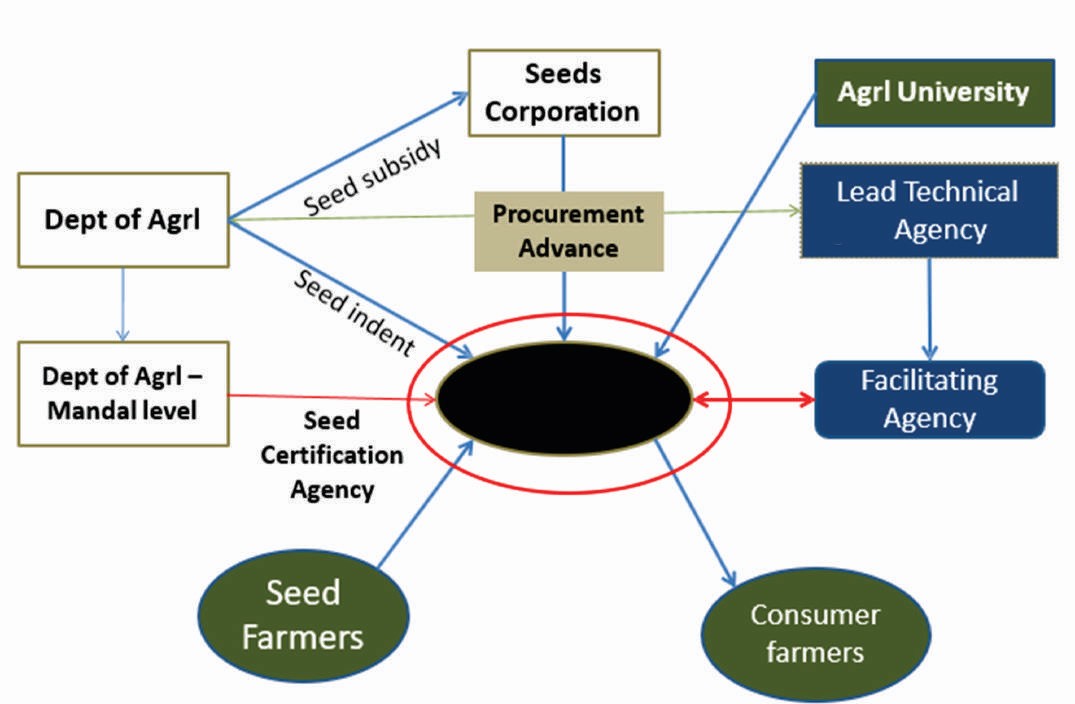
Fig: Community Managed Seed System in Anantpur district, Andhra Pradesh
What should be done?
Government should support the Community Managed Seed System (CMSS) in tribal areas, under which the seeds of all major crops being taken in these districts are produced by local farmers with complete technical guidance of seed experts. The foundation seeds will be arranged by the government and provided to selected seed producer farmers. The farmers will be trained as seed producers by experts. The seed producing farmers will be selected on certain criteria like a) farmers who are willing to take up seed production, b) who have irrigation facilities, c) who have sufficient land holding from which s/he can spare a part for seed production, and so on.
There will be one seed producing farmers per village for each crop. Thus, if seeds of five crops are required, there will be five different seed producing farmers in the village. Agriculture department will impart training to the selected potential seed producer farmer on the scientific method of quality seed production. After proper scrutiny (post training), final selection of seed producing farmers will be done. Government will provide 'foundation seed' to the seed producers and all technical support will be provided to ensure quality seed production.
On production, the seed produce will be graded and certified as per the existing seed certification protocols. The state government will purchase certified seeds from the seed producers at 'prevailing market rates of the seeds, which the government would have otherwise paid to the seed companies and the transportation cost additionally, and stored locally at block or district level.
Seed producers will be paid 80% of the price at the time of seed production and the remaining 20% will be paid when the seed is physically taken for distribution/ sale to the farmers. The seed producer will store the seeds till the sowing season and distribute the certified seeds to the farmers in the village.
Once the seeds of all major crops will be produced locally through community managed seed system, the villages will become seed sovereign and the farmers will get quality seeds at affordable prices on time.
State Millet Mission
In addition to Maize (focus on composite varieties rather than pushing hybrid varieties), other major seed related issues for agriculture in tribal areas are need for a policy to focus on millets & local landraces of rice, and promoting mixed cropping. Government of Odisha has successfully promoted millets in that state through 'Millet Mission'. Government of Rajasthan has also recently proposed to initiate 'Rajasthan Millets Promotion Mission'. Under this mission, farmers should be provided with quality seeds of millets, there has to be research on developing improved package of practices (for millets) and the government would have to procure the millets produce at minimum support price as well as utilise it in public distribution system (PDS).
Tribal farmers used to grow and consume a number of small millets like Kodo, Kutki, Sanwa, Ragi, Kangni, which are very rich in many nutrients. But, over a period of time and especially due to the distribution of wheat and rice in PDS, most of the tribal farmers have lost interest in growing small millets. In fact, many varieties of millets are already extinct or are at the brink of extinction.
Odisha Millet Mission
Odisha Millets Mission (OMM) also known as the Special Programme for Promotion of Millets in Tribal Areas of Odisha was launched by the Government of Odisha in 2017 to revive millets in farms and on plates. The aim was to tackle malnutrition by introducing millets in the public distribution system (PDS) and other state nutrition schemes. The four major objectives are production, consumption (both in urban and rural), processing and marketing. The focus is on reviving millets in farms and putting it on plates."[1]
Millets, a nutritious and climate-resilient crops, have traditionally been cultivated and consumed by tribal communities in the rainfed regions of southern Odisha. The conscious pursuit of an agricultural policy since the 1960s to meet national food security with paddy and wheat, however, led to a decline in millet production and consumption among these communities. Though millets were included for distribution via PDS system in the National Food Security Act (NFSA) 2013 and more recently recommended by NITI Aayog and the National Food Security Mission (NFSM), implementation of the same had met with marginal success due to a lack of an integrated approach to the supply-chain.
OMM may well be a game-changer in the country as it has worked out a comprehensive end-to-end programme design for promotion of millets within an agroecological framework that has the potential to be replicated in other parts of the country. A cluster-based approach for reaching out to farmers, promoting processing facilities at village and block level, encouraging household consumption of millets through celebration of local millet-based food cultures, and rigorous monitoring of the implementation partners and processes are other commendable components of the programme
What should be done?
The newly proposed Rajasthan Millet Promotion Mission should include promoting household level consumption of millets (which will help in addressing prevalent malnutrition and anaemia in tribal children and women); Improving productivity of millets by improved package of practices; setting up decentralised processing units for millets, and promoting Farmers Producers Organisations for marketing of millets.
Government should include millets in the Mid-Day-Meal scheme, in ICDS and in PDS as the Odisha government has done successfully. Government should also take up a special drive to collect seeds of small millets and local varieties of paddy available in tribal areas and get them registered as landraces and should multiply their seeds. The KVKs in tribal districts should take up the task of developing improved POP for small millets. The seed production and distribution of the small millets should be done under CMSS.
Mixed Cropping for sustainable Agriculture
The agriculture department should proactively promote mixed cropping in tribal areas. Monocropping not only increases the risk factor for farmers (risk of crop failure due to erratic rainfall, or due to quality issues in seeds), it also adversely affects biodiversity, which is essential for sustainable agriculture. Government should distribute seeds of all crops recommended under mixed cropping in the season. For example, along with maize (composite variety), seeds of black gram, green gram etc. should also be distributed in recommended proportion.
Policy Recommendations
It is extremely important that the farmers, especially in rainfed tribal regions, are not dependent on multinational companies for seed supply. Their seed sovereignty should be ensured, where they have access and control over seeds. This can be done by taking certain decisions at policy, program and practices level.
Government should proactively support and promote composite varieties of crops, rather than hybrids and genetically modified seeds.
Government should take up the initiative to produce seeds locally through farmers and farmers' groups. The seed procurement from multinational seed companies who bring seeds from out of states should be stopped immediately.
The Community Managed Seed System (CMSS) should be adopted wherein the government provides technical and initial financial support to farmers and farmers' organisations to take up quality seed production (under technical guidance of experts), stores and market the seeds locally. The CMSS programme may cover the remaining crop seed (like minor millet) and some vegetables or pulses seeds of farmers' interest. The Truthful Level seeds (TL seed) of these crops may be included for multiplication and distribution.
The newly launched State Millet Promotion Mission should promote household level consumption of millets, in order to address the problem of malnutrition in the tribal areas. This will also support tribal farmers to become self-reliant for seeds, as the millet seeds are largely produced locally.
Promote and support quality seed storage system at block & district level by providing technical and financial support to farmers' organisations and individual entrepreneurs.
The mixed cropping should be promoted by supplying seeds of mixed crops to farmers under agriculture demonstration seed kits..